FCPS, MRCS, and 25 years spent on one clear idea
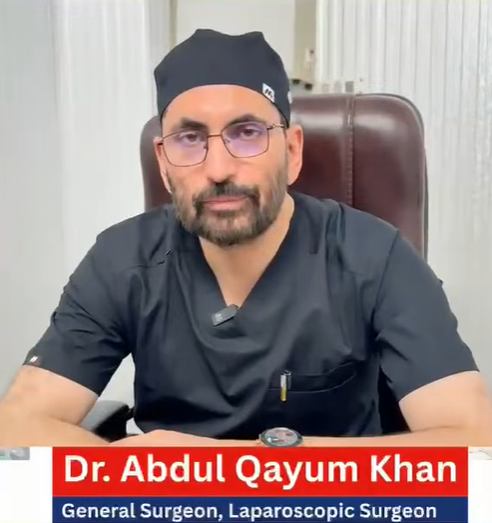
Dr. Abdul Qayyum Khan is a general surgeon practising at Health Care Hospital in Satellite Town, Rawalpindi. He holds board qualifications from both Pakistan and the United Kingdom, and has spent a quarter of a century refining an approach to gallbladder surgery that leaves patients with one small incision and a same day discharge.
- MBBSBachelor of Medicine, Bachelor of Surgery
- FCPS in SurgeryCollege of Physicians and Surgeons Pakistan
- MRCSRoyal College of Surgeons, United Kingdom
- 25 yearsIn active surgical practice
- Surgical training in the UKClinical experience within the British system
- Health Care HospitalHoly Family Road, Block F New Katarian, Satellite Town, Rawalpindi
- Appointments0336 593 5765 or 0300 527 0347
The surgeon
Two sets of board exams, one operating philosophy
Patients choosing a surgeon in Rawalpindi are usually confronted with a row of letters after a name and no way of knowing what any of them mean. Since those letters are the only objective information most people have to work with, they are worth explaining properly.
What FCPS actually represents
The Fellowship of the College of Physicians and Surgeons Pakistan is the country's specialist surgical qualification. It is not a course or a certificate of attendance. It requires years of supervised training posts in recognised hospitals, a logged operative record, an intermediate examination, and a final examination with written, clinical and viva components that a substantial proportion of candidates do not pass at first attempt. A surgeon holding the FCPS has been examined on judgement, not only on technique: when to operate, when not to, and what to do when an operation goes somewhere unexpected.
What MRCS adds on top of it
The Membership of the Royal College of Surgeons is the United Kingdom's surgical qualification, awarded through the intercollegiate examination shared by the four British and Irish surgical royal colleges. It is sat under the same conditions and marked to the same standard whether the candidate trained in Britain or elsewhere.
Holding both matters for a practical reason rather than a decorative one. Surgical practice in Pakistan and in Britain have different traditions around consent, documentation, infection control and how complications are discussed with families. A surgeon examined in both systems has had to satisfy two different sets of standards, and in this practice that shows up in unglamorous places: written consent that actually explains the risks, histopathology sent on every specimen as routine, and a willingness to tell a patient that an operation is not needed.
Verifying any of this yourself
You should not take a website's word for a doctor's qualifications, including this one. Registration of medical practitioners in Pakistan is a matter of public record and can be checked directly with the national medical regulator, and the College of Physicians and Surgeons Pakistan maintains its own register of fellows. Ask at the consultation and you will be given the registration details to check. A surgeon who is reluctant to be verified is telling you something.
The technique
Why the gallbladder became the focus
Over 25 years a general surgeon performs every operation the specialty covers, and Dr. Khan still does. But one procedure came to occupy a particular place in the practice, because the standard way of doing it kept producing a complaint that had nothing to do with the disease being treated.
Conventional laparoscopic cholecystectomy inflates the abdominal cavity with carbon dioxide to create room to work. The technique is safe and it transformed gallbladder surgery when it replaced the long open incision. But the gas irritates the underside of the diaphragm, and because the diaphragm shares its nerve supply with the shoulder, patients wake with a referred pain in the right shoulder and chest that has nothing to do with the wound. Ask patients a month after a routine laparoscopic gallbladder operation what they remember, and a striking number describe that shoulder pain rather than anything else.
The approach used in this practice takes out both of the things that generate most of the discomfort. One incision of 1 to 2 cm rather than four separate wounds, no carbon dioxide insufflation at all, and no division of abdominal muscle. Because muscle is left intact, the risk of a port site hernia developing later drops close to zero, which matters a great deal in a population where a large proportion of men return to physically demanding work.
None of this is a claim to have invented single incision surgery, which exists in the literature and is practised elsewhere. What it represents is 25 years of refining one operation to the point where it is reliably a day case in fit patients. The technique is described in detail here, and the full patient guide to gallbladder surgery is here.
What the technique does not do
It does not make the operation risk free, and it is not right for every gallbladder. A severely inflamed, gangrenous or densely scarred gallbladder may need converting to a larger incision, and the decision to do that is a mark of good surgery rather than a failure of it. Patients are told before surgery when their case looks likely to need it.
The hospital
Operating in his own facility
Health Care Hospital on Holy Family Road in Satellite Town is Dr. Khan's own hospital rather than a facility where he rents theatre time. For patients this is more consequential than it sounds.
It means the same surgeon who assessed you in clinic is the one who operates, and the theatre team, the anaesthetist and the ward staff are people he works with every week rather than whoever is on the rota that day. It means a patient who telephones at nine in the evening because a wound looks red is speaking to a team that has the notes in front of them. It means sterilisation, instrument maintenance and theatre discipline are his responsibility and nobody else's. And it means a patient whose operation turns out to be more complicated than expected is not being moved between institutions while decisions are made.
Practically, it also means scheduling flexibility. A patient travelling from Peshawar or Jhelum can be placed early on the operating list so that discharge happens in daylight rather than late at night, which is not something a visiting surgeon can usually arrange. That flexibility is the reason so much of the practice comes from outside Rawalpindi, and it is covered further on the page for patients travelling in.
How he works
What to expect in the consultation
The OPD runs busy, and patients arrive having usually been told something alarming by somebody. The consultation is built around three questions, taken in order.
Is the gallbladder actually causing your symptoms?
A scan showing stones and a patient with upper abdominal pain are not the same thing as a patient whose pain is coming from the stones. Reflux, gastritis and functional bowel disorders sit alongside silent gallstones constantly. The pattern of the pain, when it comes, how long it lasts and what brings it on tells more than the ultrasound does, which is why the history takes longer than the examination.
If it is, does it need an operation now?
Stones that have never caused symptoms often do not need removing at all, and patients are told so. Where surgery is indicated, the reasons are explained in terms of what happens if you wait rather than in terms of what the surgeon would prefer.
If it does, what does that mean for your particular circumstances?
Fitness for anaesthesia, diabetes control, blood thinners, how far you are travelling, whether somebody can stay with you overnight, and what your work involves all change the plan. The operation is the same, but the arrangements around it are not.
Second opinions are a routine part of the practice. Patients come having been told elsewhere that they need surgery, or that their case is too high risk to attempt, and both conclusions are worth examining. Bring the scan report and whatever notes you were given. If the honest answer is that no operation is needed, that is the answer you will get.
My patients are my family. Their trust is what makes me stronger every day.
میرے مریض میرا خاندان ہیں، ان کا اعتماد میری طاقت ہے
Beyond the gallbladder
The rest of the surgical practice
Gallbladder work is the best known part of the practice but it is not the whole of it. The weekly list includes hernia repair with mesh, hysterectomy under spinal or general anaesthesia, laparotomy for bowel obstruction, trauma and abdominal malignancy, urethral stricture repair, tumour resection including soft tissue, pelvic and thigh involvement, and incision and drainage of abscesses from the superficial to the deep.
A particular part of the practice is patients other surgeons are reluctant to take on. Elderly patients with cardiac and respiratory disease, patients with poorly controlled diabetes, patients on long term anticoagulation, and patients with haematological conditions including haemophilia who need surgery and have been turned away elsewhere. These cases are not harder to operate on so much as harder to plan, and the planning is where the work is: haematology input, factor cover arranged around the operation, an anaesthetic assessment built for that individual, and a discharge plan that does not assume the ordinary.
The full list of procedures is here, and high risk and complicated cases are covered in more detail here.
On the videos
Why a surgeon of 25 years posts on TikTok
It is a fair question, and the answer is not marketing.
Most patients in this country arrive for surgery having had almost nothing explained to them. They have been told they need an operation, given a date, and left to fill the gap with whatever their relatives and the internet supply. That gap gets filled with herbal flushes, with stories about somebody's uncle who died under anaesthesia, and with a genuine terror of the operating theatre that makes the whole experience worse than it needs to be.
Short videos explaining what the operation involves, and interviews with patients recorded on the ward afterwards, close that gap better than a leaflet does, and they reach people who would never read one. Patients arriving for a consultation having already watched the operation explained are calmer, ask better questions, and give more genuinely informed consent.
Everything published is with the patient's explicit permission, given at the time, and it can be withdrawn at any point without giving a reason. The full video library is here.
Questions
Things patients ask before booking
Does Dr. Khan operate himself, or does an assistant do it?
He performs the operation himself. In a practice of this size the surgeon you consult is the surgeon who operates, which is not always the case in larger institutions where the list is shared.
How many of these operations has he done?
Ask him directly at the consultation. Volume is a legitimate thing to ask any surgeon about, along with what their conversion rate to open surgery is and what they do when a complication occurs. A surgeon who becomes defensive about these questions is one to be cautious of.
Can I see him for something that is not gallbladder related?
Yes. The OPD covers the full range of general surgical conditions, and a significant share of the work is hernia, abdominal emergencies, tumour surgery and gynaecological procedures. Gallbladder surgery is the best known part of the practice rather than the only part.
Do you take referrals from other doctors?
Yes, from GPs and specialists both, with same week OPD slots where the diary allows. Details are on the page for referring doctors.
What if I need surgery but cannot afford it right now?
Raise it at the consultation rather than quietly delaying treatment, because a gallbladder that becomes infected while you wait turns a planned day case into an emergency admission that costs considerably more. What the operation involves and what affects the figure is set out on the cost page.
I live abroad and visit Pakistan occasionally. Can surgery be arranged around a trip?
It can, and a number of patients do exactly this, but it needs planning rather than turning up in the last week of a visit. You should be in the country long enough for the pre-operative assessment, the operation, the wound check and a review before flying. More for overseas and visiting patients here.
Read next
Bring your scan report and get a straight answer
OPD at Health Care Hospital, Satellite Town. Walk in during clinic hours or book a slot by phone or WhatsApp. If the answer turns out to be that you do not need an operation, that is what you will be told.