For referring doctors
Written for colleagues rather than patients. What is accepted, what gets a same week slot, what to send with a referral, what comes back to you afterwards, and the direct line for discussing a case before you send it.
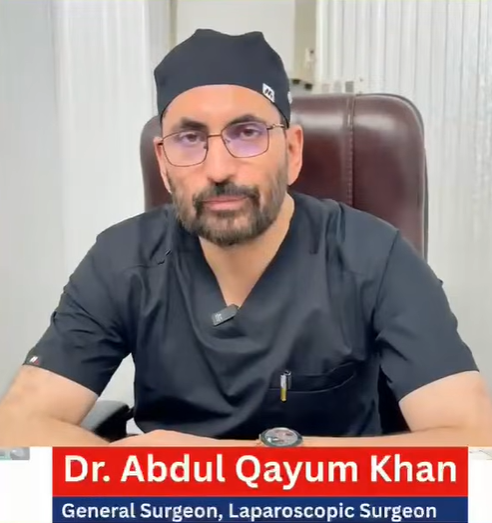
What this practice offers your patient
General surgery, elective and emergency, at Health Care Hospital in Satellite Town. The facility is Dr. Khan's own, which in referral terms means three things that matter to you: the surgeon who assesses your patient is the one who operates, theatre scheduling is flexible enough to accommodate an urgent case without displacing it to a waiting list, and there is a single point of contact for the whole episode rather than a department.
The practice's particular focus is cholecystectomy performed through a single 1 to 2.5 cm incision without CO2 insufflation. For your patients that generally means day case discharge, with return to normal activity varying considerably between individuals. The absence of insufflation is worth noting specifically for your cardiac and respiratory patients, in whom raised intra-abdominal pressure and the CO2 load are not trivial considerations.
Histopathology is sent on every specimen as routine, and the report goes back to the referrer along with the operation note.
Referral priority
What gets seen, and how quickly
Same week OPD slots are available for the categories below where the diary allows. Telephone rather than relying on the form if your patient needs to be seen quickly.
Acute cholecystitis, cholangitis, gallstone pancreatitis
Telephone directly rather than referring in writing. These need assessment the same day and a written referral introduces a delay that serves nobody.
Obstructive jaundice, suspected CBD stone
Send liver function tests and the duct measurement from ultrasound if you have them. These usually need MRCP and a staged plan with ERCP before cholecystectomy.
Symptomatic cholelithiasis, recurrent biliary colic
The commonest referral and the core of the practice. Same week slot where possible, particularly where attacks are becoming more frequent.
Gallbladder polyps, thickened or calcified wall
Polyps of 10 mm or more, interval growth on serial imaging, or a porcelain gallbladder. Worth sending the serial scans rather than only the most recent one.
Patients declined elsewhere on risk grounds
Elderly and frail patients, cardiac and respiratory comorbidity, poorly controlled diabetes, anticoagulation, hemophilia and other coagulation disorders. These are assessed and planned rather than refused by default, and where the original advice was correct that will be confirmed back to you.
Hernia, hysterectomy, urethral stricture, abscess, soft tissue and pelvic tumors
Elective general surgery across the usual range, including circumcision in medically complex patients.
Second opinions
Both ways round: patients told they need an operation, and patients told they cannot have one. Send the reasoning if you have it, since it is more useful than the conclusion.
Undifferentiated upper abdominal pain with incidental stones
Genuinely welcome. A proportion of these turn out to be reflux, gastritis or functional bowel disease with silent stones alongside, and they will be told that rather than listed for surgery.
Making the referral
What to send
A photograph of a handwritten note on WhatsApp is entirely acceptable. There is no form to complete and no portal to log into.
- Patient name, age and a contact number the clinic can call to arrange the slot directly.
- The clinical question. One line is enough. What you are asking for shapes the appointment more than a long history does.
- Ultrasound report and films where available, since the duct measurement and wall thickness change the urgency.
- Liver function tests and recent bloods, particularly where jaundice or a duct stone is in question.
- Comorbidities and current medication, especially anticoagulants, antiplatelets, diabetic medication and anything cardiac.
- Previous abdominal surgery, with the operation note if you have access to it. This changes the surgical plan more than almost anything else.
- Your own contact details, so the operation note and histopathology come back to the right person.
Discussing a case before referring
Telephone 0336 593 5765 or 0300 527 0347. Colleagues are welcome to ring about a patient they are uncertain about, including to establish that surgical referral is not the right answer. That conversation is more useful than a referral that turns out to be unnecessary.
After the referral
What comes back to you
- The assessment outcome, including where the decision is against surgery and why, which matters as much to you as a listing does.
- The operation note, with the findings and anything that altered the plan, including conversion and the reason for it.
- The histopathology report on the specimen, sent as routine on every case.
- A discharge summary listing medication, wound care and the follow up arrangement.
- A direct call rather than a letter where there is an unexpected finding, a complication, or anything that changes your ongoing management of that patient.
Shared follow up for distant patients
A large share of this caseload travels in from Khyber Pakhtunkhwa, the Pothohar belt, Hazara and Azad Kashmir. For those patients, wound checks and routine review are frequently better done locally than by asking someone to drive three hours to have an incision looked at.
If you are willing to review your own patient post-operatively, say so with the referral. They will go home with the operation note and discharge summary so you know exactly what was done, and the clinic is available by telephone to discuss anything that arises. Sutures are absorbable, so there is nothing to remove.
Scope
What is not taken on here
Stating this plainly saves everyone a wasted appointment. This is a general surgical practice, so referrals needing pediatric surgery, cardiothoracic, neurosurgical, vascular reconstruction, transplant or dedicated oncological services beyond resection are better directed to the appropriate tertiary center. Where a patient arrives whose problem sits outside this scope, they will be told and redirected rather than kept.
Complex hepatobiliary reconstruction, including the management of a major bile duct injury, belongs in a specialist hepatobiliary unit, and a referral in that direction will be made rather than attempted locally.
Questions
From referring colleagues
Is there a referral form?
No. A photograph of a handwritten note on WhatsApp, or a telephone call, is sufficient. Include a contact number for the patient so the slot can be arranged with them directly.
Can I refer a patient who may not need surgery?
Yes, and those referrals are welcome. A proportion of upper abdominal pain with incidental stones turns out to be reflux, gastritis or functional bowel disease, and those patients are told so rather than listed. You will get that back in writing.
How quickly can an urgent patient be seen?
Telephone rather than writing for anything urgent. Acute cholecystitis, cholangitis, pancreatitis and obstructive jaundice are assessed the same day. Because the theatre list is not shared with other units, an urgent case can usually be accommodated without displacing it.
Will my patient be charged for the consultation if surgery is not indicated?
Discuss fees with the clinic directly so you can tell your patient accurately before they travel. What will not happen is a patient being listed for an operation they do not need in order to justify the visit.
Can I send a patient with hemophilia or on anticoagulation?
Yes. These need hematology input, factor assays and cover arranged across the operative and healing period, which is planning rather than an obstacle. Send the hematologist's details and recent assay results with the referral.
Do you accept patients from outside Rawalpindi and Islamabad?
Regularly, from across Khyber Pakhtunkhwa, the Pothohar belt, Hazara and Azad Kashmir. Mention the distance with the referral so the operating slot and discharge can be planned around the journey. Details are on the page for traveling patients.
Clinical pages
Refer a patient, or ring to talk one through
Same week OPD slots where the diary allows. Urgent presentations are better telephoned than written.