General surgeon in Rawalpindi
Dr. Abdul Qayyum Khan operates at Health Care Hospital on Holy Family Road in Satellite Town, a few minutes off Murree Road. Gallbladder removal through a single 1 to 2 cm incision with no gas, plus the full range of general surgery, for patients across the city.
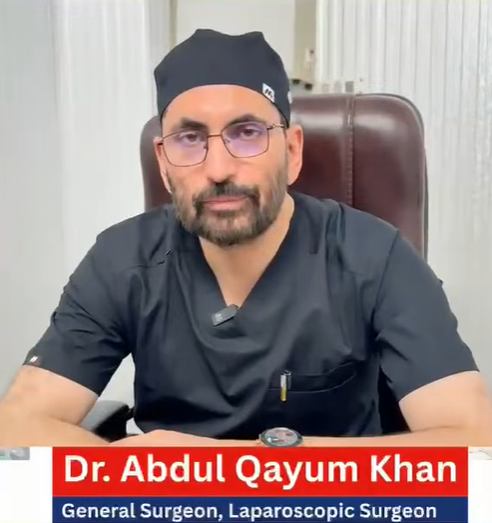
Choosing a surgeon in a city with no shortage of them
Rawalpindi is not short of surgeons. Between Holy Family Hospital, Benazir Bhutto Hospital, the DHQ, the cantonment hospitals and dozens of private setups along Murree Road and in Saddar, a patient with gallstones has plenty of doors to knock on. That abundance is not always a comfort. When every clinic says the same thing in the same words, the decision stops being about information and becomes about whoever a relative happened to recommend.
So it is worth being concrete about what is different here rather than making the usual claims. Three things.
The first is the technique. Most units in the city perform gallbladder removal through four separate incisions with carbon dioxide pumped into the abdomen. That is a good operation and it works. But the gas irritates the diaphragm, and because the diaphragm shares nerve supply with the shoulder, patients spend the following days with a referred pain in the right shoulder that has nothing to do with their wound. The approach used here is one incision of 1 to 2 cm with no gas at all and no division of muscle, which removes that problem entirely and takes the risk of a later port site hernia close to zero.
The second is that this is Dr. Khan's own hospital rather than a facility he rents theatre time in. The surgeon who sees you in the OPD is the surgeon who operates, the theatre team is the same team every week, and a patient who telephones at nine in the evening reaches people who have the notes in front of them.
The third is that both sets of board examinations have been sat. The FCPS from the College of Physicians and Surgeons Pakistan and the MRCS from the Royal College of Surgeons in the United Kingdom. What those qualifications actually require is explained here, along with how to verify them yourself rather than taking a website's word for it.
Getting here
Where the hospital sits, and why that matters
Health Care Hospital is in Block F New Katarian on Holy Family Road, Satellite Town. In practical terms that puts it just off Murree Road on the Islamabad side of the city, which means most patients reach it without having to cross the congestion of Raja Bazaar and the old city.
From Commercial Market and Chandni Chowk it is a short drive. From Committee Chowk, Liaquat Bagh and Asghar Mall it is a matter of minutes up Murree Road. Patients coming from Saddar, Bank Road and the Mall area come up through Marrir Chowk. From the Cantt side, Chaklala Scheme 3, Westridge, Gulrez and the airport housing societies, the route in is along Peshawar Road or via Murree Road depending on traffic. Patients from Tench Bhata, Dhoke Kala Khan, Dhoke Syedan, Pirwadhai, Morgah, Adiala Road and the Chakri Road side all come in on the same spine.
The Metro bus is genuinely useful here, which is worth saying because a lot of patients assume a hospital visit means arranging a car. Rehmanabad and Chandni Chowk stations are both within easy reach of Holy Family Road, so patients from as far down the line as Saddar, Committee Chowk or even the Islamabad end can get most of the way in without traffic. For a consultation that works well. For the day of surgery you will need a private vehicle and somebody with you, because you cannot travel home alone after a general anaesthetic.
Areas patients commonly travel in from
Satellite Town, Commercial Market, Chandni Chowk, Rehmanabad, Asghar Mall, Committee Chowk, Liaquat Bagh, Saddar, Bank Road, Raja Bazaar, Chaklala Scheme 3, Westridge, Gulrez, Peshawar Road, Tench Bhata, Dhoke Kala Khan, Dhoke Syedan, Pirwadhai, Morgah, Adiala Road, Chakri Road, Bahria Town, DHA, Gulraiz, Rawat and Koral.
What patients arrive with
The pattern in this city
After 25 years of OPD in Rawalpindi some patterns are hard to miss, and two of them are worth flagging because both are avoidable.
People present late, and the operation gets harder
A very large number of patients arrive having had episodes of right upper abdominal pain for months or years. They have been managing it with antacids from the chemist, with restricted eating, and with the assumption that it is gas or a stomach problem. By the time the scan is done and the stones are found, several attacks have already happened.
The consequence is surgical rather than moral. A gallbladder that has been inflamed repeatedly becomes thick walled, scarred and stuck to the structures around it. The planes a surgeon works along get obliterated. That turns a 40 minute day case into a longer, more difficult operation with a higher chance of needing conversion to a larger incision. The same gallbladder, treated after the first or second attack, is straightforward.
The herbal flush costs people months
Patients regularly arrive having spent weeks on olive oil and lemon regimens, or on preparations bought on a relative's recommendation, and having passed soft green pellets in the stool which they were told were their stones. They were saponified oil. The stones are still there, visible on the repeat scan, and in the meantime the gallbladder has had two more attacks.
Medical dissolution does genuinely exist, but it works only for small purely cholesterol stones in a gallbladder that still empties well, takes months to years of tablets, succeeds in a minority of carefully selected patients, and the stones usually come back once treatment stops. Diet control reduces how often you get attacks. Neither removes a stone. The full picture on gallstones is here.
Who tends to be affected
The recognised risk factors are unremarkable and worth knowing: being female, increasing age, pregnancy and multiple pregnancies, obesity, rapid weight loss including after crash dieting, diabetes, a family history of gallstones, and a diet heavy in fried food and saturated fat. That last item describes a good deal of ordinary cooking in this part of the country, which is one reason gallstone disease is such a routine part of general surgical work here.
Practical
What a Rawalpindi patient can expect
Living in the same city as the hospital makes almost everything simpler, and it is worth spelling out how.
The consultation
Walk in during OPD hours or telephone ahead to reduce waiting. Bring your ultrasound report and films, any earlier scans, and the actual boxes of every medicine you take. The history takes longer than the examination, because the pattern of your pain tells more about whether the gallbladder is the culprit than the scan does.
Tests, usually the same week
Blood count, liver and kidney function, blood sugar, clotting profile and hepatitis screening as standard, with an ECG and chest film for older patients or anyone with a cardiac history. Being local means these can be done, reviewed and acted on without a second long journey.
The operation
General anaesthesia, usually 30 to 60 minutes of operating time, one incision of 1 to 2 cm, no gas. A badly inflamed or scarred gallbladder takes longer, and that time is spent rather than rushed.
Home the same evening
Once you are fully awake, drinking without vomiting, passing urine, walking unaided and comfortable on tablets, you go home. Arrange a driver in advance and have a responsible adult stay the first night. For a patient twenty minutes away this is entirely routine.
Review at about a week
The wound is checked and the histopathology report on the removed gallbladder is discussed, which is sent as routine on every specimen. Being in the city means this is a short visit rather than a day lost, and anything that needs looking at sooner can be seen the same day.
Desk work is usually realistic after three to five days and driving after about a week, once you could perform an emergency stop without hesitating. Anyone whose work involves lifting, and that is a great many people in this city, should plan on two to three weeks rather than trying to prove something in the second. Recovery is covered week by week here.
Beyond gallbladder
Other general surgery for Rawalpindi patients
Gallbladder work is the best known part of the practice but the OPD covers general surgery in full, both elective and emergency.
- Hernia repair for inguinal, umbilical and incisional hernias with mesh reinforcement, under general or local anaesthesia.
- Hysterectomy under spinal or general anaesthesia with full assessment beforehand and structured follow up.
- Laparotomy and major abdominal surgery for bowel obstruction, perforation, trauma and abdominal malignancy.
- Urethral stricture repair for obstruction, straining and poor urinary flow.
- Circumcision including medically complex patients, among them those with haemophilia and other bleeding disorders.
- Tumour surgery and abscess drainage, from superficial collections to deep tissue, under local or general anaesthesia.
Second opinions are routine. Patients arrive having been told elsewhere either that they need an operation or that their case is too risky to attempt, and both conclusions deserve examining. If the honest answer is that no surgery is needed, that is the answer you will get.
When not to wait for an OPD slot
Severe constant abdominal pain, fever with shaking chills, yellowing of the eyes or skin, persistent vomiting, or a hard swollen abdomen all need assessment the same day. Telephone 0336 593 5765 or come to Health Care Hospital directly rather than waiting for an appointment.
Questions
From patients in Rawalpindi
Do I need an appointment or can I walk in?
Both work. The OPD takes walk in patients as well as booked ones. Telephoning ahead simply means less waiting, and on a day with a long operating list it means you are not making the trip for nothing.
Can I get to Satellite Town on the Metro?
Yes, and for a consultation it is often faster than driving on Murree Road. Rehmanabad and Chandni Chowk stations are both within easy reach of Holy Family Road. On the day of surgery you need a private vehicle and somebody with you, because travelling home alone after a general anaesthetic is not safe.
I already have an ultrasound from another lab. Is it acceptable?
Yes, bring the report and the films. A repeat scan is only asked for if the original is unclear, if it is several months old, or if your symptoms have changed since. There is no interest in making you pay for the same test twice.
My relative was operated on at a government hospital and had four cuts. Why is this different?
Four small incisions with carbon dioxide insufflation is the standard laparoscopic technique used in most units, here and internationally. It is a sound operation. The approach used in this practice uses one incision of 1 to 2 cm and no gas, which avoids the shoulder and chest pain the gas causes and leaves abdominal muscle undivided. The difference is set out in full here.
What does it cost?
It depends on the anaesthetic, theatre time, whether you need an overnight bed and what pre-operative testing your case requires, so a figure is given at consultation once the picture is clear. What is included and what changes the number is explained here.
I have diabetes and high blood pressure. Is surgery still safe?
Usually yes, and both are extremely common among patients here. What matters is how well controlled they are, which is what the pre-operative assessment measures. Diabetic medication is adjusted around the fasting period and blood pressure tablets are generally continued. Bring the boxes so nothing is guessed at.
Can a female family member be present throughout?
Yes. A relative can accompany you in the OPD and wait with you before and after surgery, and for women patients this is encouraged rather than merely permitted. Say so when booking if it matters to you and the visit will be arranged around it.
Bring your scan report to the OPD
Health Care Hospital, Holy Family Road, Block F New Katarian, Satellite Town. Walk in during clinic hours or book a slot by phone or WhatsApp. If your stones do not need surgery yet, that is what you will be told.