General surgeon for Charsadda
Out to the motorway and down to Islamabad, roughly two and a half hours to Satellite Town. This page is about deciding whether that journey is the right call and, if it is, how to make it once rather than repeatedly.
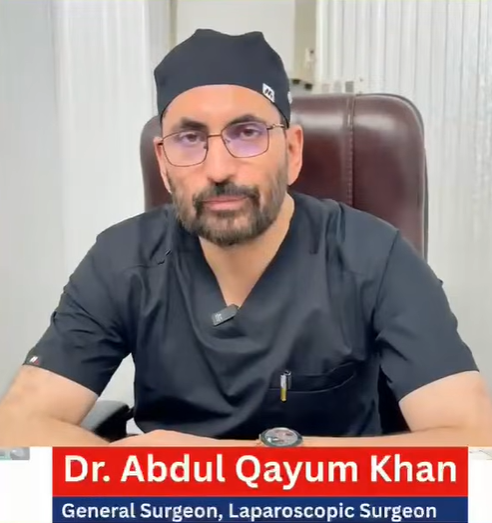
Worth asking whether you should travel at all
Charsadda is served by hospitals in the district and by the larger institutions in Peshawar half an hour away. For most gallbladder operations that is where treatment should happen, and a website telling you otherwise would not be doing you a service.
Patients who do make the journey to Rawalpindi generally have one of three specific reasons. The technique, being a single incision of 1 to 2.5 cm with no carbon dioxide and no abdominal muscle divided. A case that has already been turned down elsewhere, whether for a bleeding disorder, cardiac risk, or a gallbladder judged too scarred to attempt. Or wanting continuity, meaning the surgeon who assessed you is the one who operates and the same team sees you afterwards.
If none of those describe your situation, telephone and ask rather than driving two and a half hours to be told you could have been treated at home.
The journey
The route and what it costs you in time
From Charsadda city the usual route is out through Peshawar to the motorway, or across towards Mardan and onto the M-1 at Rashakai, with the choice depending on traffic and where exactly you start. Either way allow around two and a half hours to Satellite Town in normal conditions.
From Tangi and Shabqadar the journey is longer at the start before you reach a main road. From Prang, Umarzai and Nisatta the approach into Charsadda city comes first.
Health Care Hospital is on Holy Family Road in Block F New Katarian, Satellite Town, just off Murree Road on the Islamabad side of Rawalpindi, so you arrive without crossing the center of the city.
Tell the clinic where you are coming from
That one detail sets your place on the operating list, whether a bed is held overnight, and how follow up is arranged. Call 0336 593 5765 or send it on WhatsApp.
Planning
Compressing it sensibly
Send the ultrasound report and any recent blood tests ahead on WhatsApp. With those the clinic can say whether the picture is straightforward, and where it is, consultation, assessment and surgery can usually happen within one stay of a few days.
Where one trip will not work: abnormal liver function tests, a dilated bile duct on your scan, or a cardiac or diabetic issue to settle first. Those need more imaging or an anesthetic review and cannot safely be rushed. You will be told before you travel.
Practical details that matter at this distance
Fasting is counted from when you leave home, not when you arrive: six hours without food, two without clear fluids. Bring one adult who can stay with you for twenty four hours rather than someone who drops you and returns. Bring the scan report and films, any previous operation notes, and the actual boxes of your medicines.
Plan on an overnight stay rather than driving back the same evening. Two and a half hours of road after an anesthetic is the arrangement most likely to go wrong, and an overnight bed with a morning review costs far less than a complication developing on the motorway.
Afterwards
Follow up without repeating the drive
Review happens at about a week in every case, so the wound can be checked and the laboratory report on the removed gallbladder discussed. From Charsadda you should not be making that journey again for a four minute look.
A photograph taken in good daylight and sent on WhatsApp answers it, and the histopathology result is discussed by telephone. The sutures dissolve on their own. Shared follow up with your own doctor in Charsadda or Peshawar works well, and you will leave with the operation note and discharge summary so they know exactly what was done. The clinic is available to speak with them directly.
Do not drive back while unwell
Fever with shaking chills, yellowing of the eyes or skin, pain worsening rather than settling, persistent vomiting, a hard swollen abdomen or breathlessness. Be seen at the nearest hospital and telephone 0336 593 5765 from there.
Understanding the problem
Gallstones, and why they cause trouble
The gallbladder is a small pouch under the right side of the liver whose only job is storage. The liver makes bile continuously, the gallbladder holds and concentrates it, and squeezes it into the intestine when a fatty meal arrives. It is a holding tank rather than a factory, which is why it can be removed without replacing anything.
Stones form when bile becomes too concentrated for what it is carrying, so cholesterol or pigment comes out of solution and crystallizes, and when the gallbladder does not empty briskly enough to flush those crystals out before they grow. Concentration plus stasis is the whole mechanism.
Who tends to get them
- Women more than men, particularly during childbearing years, because oestrogen increases cholesterol in bile while progesterone slows gallbladder emptying.
- Pregnancy, and more so repeated pregnancies, through the same hormonal mechanism.
- Increasing age, with prevalence rising steadily through adult life.
- Obesity, and separately rapid weight loss, including after crash dieting.
- Diabetes and the metabolic syndrome.
- A family history, which is a genuine and underappreciated factor.
- A diet heavy in fried food, ghee and saturated fat with low fiber, which describes a great deal of ordinary cooking in this region.
- Skipping meals or long fasting periods, since a gallbladder that is not asked to empty sits full of concentrated bile.
Can they be dissolved instead?
This is the question patients ask most, so here is the straight answer. Bile acid tablets can dissolve small, purely cholesterol stones in a gallbladder that still empties well, but treatment runs for months to years, succeeds in a minority of carefully selected patients, and stones return in a large proportion once the tablets stop, because the gallbladder that made them is unchanged.
Herbal flushes and olive oil with lemon regimens do not dissolve stones. The soft green pellets that appear in the stool afterwards are saponified oil, not stones, and the stones remain clearly visible on a repeat scan. This matters because patients lose months to them and sometimes arrive eventually with an infected gallbladder that would have been a simple day case earlier.
Diet control is genuinely worthwhile but understand what it does. Avoiding fried food, ghee, cream and rich meat, eating smaller and more regular meals rather than skipping them, and losing weight gradually will all reduce how often you get attacks. None of it removes a stone.
The operation
What makes this technique different
Conventional keyhole surgery uses four incisions and inflates the abdomen with carbon dioxide. The gas presses on the underside of the diaphragm, and because the diaphragm shares its nerve supply with the shoulder tip through the phrenic nerve, patients wake with referred pain in the right shoulder and chest for several days. It has nothing to do with the wounds and nothing applied to the shoulder relieves it.
Here the gallbladder comes out through a single incision of 1 to 2.5 cm, with no carbon dioxide and without dividing abdominal muscle. That removes the referred pain entirely, leaves one small wound rather than four, and because the muscle layer is never cut, the risk of a port site hernia developing months or years later drops close to zero.
For a patient facing two and a half hours in a car on the way home, the absence of gas pain and bloating makes a practical difference to the journey rather than being a theoretical advantage. The technique is explained in full here, including where it is not the right answer.
Questions
From patients in Charsadda
Should I travel to Rawalpindi or be treated nearer home?
For most straightforward gallbladder operations, nearer home. Patients who travel usually do so for the single incision gas free technique, because a case was declined elsewhere on risk grounds, or for continuity of surgeon. Telephone and ask before making the drive.
How long does the journey take?
Around two and a half hours from Charsadda city, out through Peshawar or across to the M-1 at Rashakai. Tangi and Shabqadar add time before you reach a main road.
Can consultation and surgery be done on one trip?
Often yes, if the ultrasound report and recent blood tests are sent ahead and the picture is straightforward. Abnormal liver tests, a dilated bile duct or a cardiac or diabetic issue require investigation first.
Can my own doctor handle the follow up?
Yes, and from this distance that is usually sensible. Take the discharge summary and operation note so they know exactly what was done, and the clinic will speak with them directly if needed.
I have been refused surgery elsewhere. Is it worth coming?
Telephone first with whatever you were told and any reports you were given. Sometimes the original advice is correct and will be confirmed, which saves you the journey. Sometimes it reflects what one unit was set up to handle rather than what is possible.
How long can I safely leave it?
If you have genuinely never had symptoms, potentially indefinitely, with review if things change. Once attacks have begun there is no safe interval anyone can promise, because the next episode may be biliary colic or it may be pancreatitis. Most surgeons advise treating within weeks to a few months rather than years.
I am pregnant and have been told I have stones.
Mild symptoms are usually managed conservatively until after delivery. Where attacks are recurrent or there has been pancreatitis, surgery during pregnancy is sometimes the safer course, most often in the second trimester and planned jointly with the obstetric team. It is neither undertaken lightly nor automatically avoided.
Is the pain always after fatty food?
Classically yes, because fat triggers the gallbladder to contract, but not invariably. Attacks also happen at night with no meal beforehand. The absence of a fatty meal does not rule out biliary colic if the rest of the pattern fits.
Telephone before you plan the journey
Send your ultrasound report on WhatsApp and the clinic can tell you whether this trip is worth making, and whether you need an operation at all.